
KNOWLEDGE RESOURCE
How Can I Make My Website More Visible in ChatGPT, Gemini and Google AI Results?

- Guide
- AI & Knowledge
- Updated 8 September 2026
- 13 min read
AI search visibility is becoming part of how businesses are discovered online, as people increasingly use tools like ChatGPT, Gemini and Google AI to research products, services and expertise.
The way people discover businesses online is changing.
Someone looking for a product, service or expert may still start with Google.
But they may also ask ChatGPT.
Use Gemini.
Read a Google AI Overview.
Or have an AI system compare several options before they ever visit a website.
Naturally, businesses are beginning to ask:
How do we make sure AI can find us?
There is no button you can switch on that guarantees an AI platform will mention your business.
And there is no single piece of “AI schema” that suddenly makes a website visible everywhere.
The stronger approach is to improve the quality, accessibility and structure of the information your business already publishes.
That work benefits people first.
It also gives search engines and AI-powered systems a better foundation from which to discover and understand your business.
THE SHORT ANSWER
First, understand what “AI visibility” actually means
AI visibility is not one single thing.
Your business might appear in several different ways.
For example:
- your website may be linked as a source
- your brand may be mentioned in an answer
- one of your products may be surfaced
- your local business information may appear
- an article may support part of an AI-generated answer
- an AI assistant may retrieve information directly from your site
- someone may discover you through a traditional search result alongside an AI response
These experiences are controlled by different platforms with different systems.
That means there is no universal “AI ranking”.
A business might appear in Google’s AI features but not ChatGPT.
Another might be cited by ChatGPT for one question but not another.
Gemini may provide links for some responses and no source links at all for others. Google says Gemini can use public information from Google Search, while related sources may include public websites, but not every Gemini response provides sources.
So the goal should not be:
How do we trick every AI into mentioning us?
A much better question is:
How do we make our business information genuinely useful, accessible and understandable wherever people search for it?
1. Make sure your website can actually be discovered
AI systems can only use information they can access. Your website needs to be crawlable, not blocked by robots.txt, and available to the relevant AI crawlers.
Public website
Your content is live and accessible
Crawler can
access it
(e.g. OAI-SearchBot or GPTBot)
Content can be
indexed or retrieved
May be considered
by search and
AI systems
Before thinking about AI optimisation, your public website needs to be technically accessible.
That sounds obvious.
But websites frequently block important content without realising it.
A search or AI crawler may encounter:
- noindex directives
- blocked robots.txt rules
- inaccessible JavaScript content
- incorrect canonical URLs
- staging-site settings left active
- broken internal links
- pages missing from navigation
- server or firewall restrictions
For Google’s generative AI search features, pages need to meet normal Search technical requirements and be eligible for indexing and snippets. Google says the same crawling and indexing fundamentals continue to apply to these AI experiences.
For ChatGPT Search, OpenAI says public websites can appear in search, and recommends allowing OAI-SearchBot if you want your content eligible for summaries and snippets. Placement is still not guaranteed.
Important: OAI-SearchBot and GPTBot are not the same thing
These are easy to confuse.
OAI-SearchBot relates to discovery for ChatGPT Search.
GPTBot relates to content that may be used for training OpenAI’s models.
A business can therefore make decisions about search visibility separately from decisions about model training.
2. Publish information people genuinely need
AI visibility does not change the basic reason your website exists.
People still need useful information.
That might include:
- what you sell
- who it is for
- how it works
- what it costs
- how different options compare
- delivery information
- technical specifications
- frequently asked questions
- policies
- examples
- expert guidance
- evidence of experience
Google’s current generative AI guidance specifically encourages unique, useful, non-commodity content rather than producing large amounts of generic information that could have come from anywhere.
That distinction matters.
An article called:
7 Tips for Better Marketing
may say nothing unique about your expertise.
An article explaining:
Why we changed the checkout flow on a WooCommerce store and what happened afterwards
contains actual business experience.
Your own expertise is difficult for another website to reproduce.
That makes it valuable to customers regardless of whether AI is involved.
3. Answer the questions surrounding the buying decision
A website should not only explain what the business sells.
It should reduce uncertainty.
Think about the questions people ask before they contact you or buy.

For a product-based business, that may include:
- Which option is right for me?
- What size do I need?
- What is it made from?
- How long will it last?
- How should I care for it?
- What happens if it does not fit?
- How quickly will it arrive?
- What is the difference between these two products?
For a service business:
- Who is this service for?
- What is included?
- How long does the process take?
- How much does it cost?
- What happens after I enquire?
- What do I need to prepare?
- What makes this different from another option?
These questions are valuable because they represent real decision-making.
Answering them properly improves the website for people first.
It also creates clearer information for systems trying to understand what your business offers.
4. Organise the knowledge behind the website
This is where our Knowledge Catalogue approach becomes relevant.
A business may have excellent information.
But if that information is scattered across:
- product pages
- blogs
- FAQs
- PDFs
- support tickets
- emails
- team documents
- people's heads
it becomes difficult to keep consistent.
You may have one answer on the website and another in a PDF.
A product description may be updated while an FAQ remains outdated.
An AI system may encounter both.
A Knowledge Catalogue helps organise the approved knowledge underneath those experiences.
It can define:
- the question
- the approved answer
- the topic
- related information
- ownership
- review dates
- audience
- access level
- AI approval
The goal is not to create content purely for machines.
The goal is to create a more dependable source of business knowledge.
That knowledge can then support the website, customer support, internal teams and approved AI systems.
5. Make relationships between information clear
A useful website is not just a collection of isolated pages.
The information should connect.

For example:
Product
can connect to:
- buying guide
- FAQs
- care instructions
- delivery
- warranty
- related products
- technical information
Or:
Service
can connect to:
- who it is for
- process
- pricing
- case studies
- frequently asked questions
- next step
Those relationships help visitors explore naturally.
They also create additional context around the subject.
Internal linking is therefore not simply an SEO tactic.
It helps describe the information architecture of the website.
6. Use structured data appropriately
Structured data helps search engines interpret certain types of information on a page.
Depending on the website, that might include supported schema for:
- organisations
- local businesses
- products
- articles
- breadcrumbs
- events
- people
- reviews
- other eligible content types
Myth
Structured data helps clarify supported entities and content types.
Reality
Structured data does not guarantee your website will appear in AI results.
But this is an area where AI marketing claims can become exaggerated.
Google explicitly says there is no special schema.org markup required for generative AI search and warns against overfocusing on structured data as an AI visibility tactic.
Structured data is still useful.
We use it because it helps define information clearly and can support eligibility for relevant Search features.
We just do not treat it as a magic AI switch.
7. Strengthen the entities behind the website
An AI system should not have to guess who your business is.
Your important business information should be consistent.
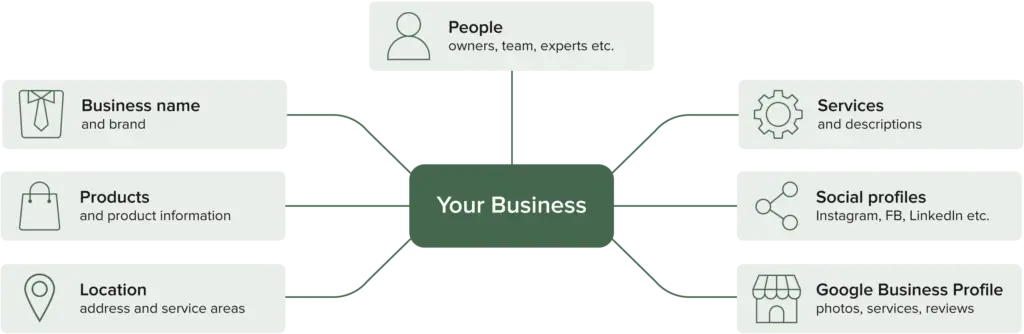
That includes things such as:
- business name
- people behind the business
- location
- products
- services
- areas of expertise
- contact information
- social profiles
- relevant third-party profiles
For local businesses, keeping Google Business Profile information accurate is particularly important.
For eCommerce businesses, accurate product information and appropriate merchant data can help Google understand and surface products across Search experiences. Google specifically recommends maintaining business, local and shopping information as part of its generative AI search guidance.
The aim is consistency.
The more clearly the web describes the same real business, products and expertise, the less ambiguity there is around those entities.
8. Demonstrate experience, not just information
AI systems value real experience, original insights and practical expertise. Go beyond generic information by sharing what you have done, what you have learned and what makes your perspective unique.
Generic information
- Rewrites what's already online
- High-level and surface-level
- Could be written by anyone
Real experience
- Based on first-hand knowledge
- Includes examples, insights and outcomes
- Shows what makes your perspective unique
Your website should contain things only your business can credibly say.
For Mojo, that could include:
- how we structure WooCommerce builds
- decisions we made during a real project
- why we chose one solution over another
- mistakes we commonly find on existing websites
- our Knowledge Catalogue methodology
- examples from client work
- what we learned from implementing a particular system
For another business, the evidence will look different.
The important part is that expertise becomes visible.
Generic content tells the internet:
We know the same things everyone else knows.
Original experience tells it:
This is what we know because we have actually done the work.
Google’s latest guidance explicitly distinguishes unique, expert or experience-led information from generic “commodity content”.
9. Do not create hundreds of pages for every possible AI question
This is an important one.
Businesses are increasingly being told to identify every possible question someone might ask an AI and publish a separate page for each one.
That can quickly become:
- repetitive
- thin
- difficult to maintain
- artificial
- unpleasant for actual visitors
Google specifically warns against creating large quantities of pages around every query variation simply to manipulate rankings or generative AI responses.
You do want to understand the questions your audience asks.
But several closely related questions may belong inside one excellent resource.
The aim is not maximum page count.
It is maximum usefulness.
10. You do not need to write differently “for AI”
AI systems are more capable of understanding language than traditional keyword matching sometimes suggests.
That means your website does not need to sound robotic.
You do not need to repeat the same phrase unnaturally.
You do not need a special “AI version” of every article.
Write for people first. Structure it so machines can understand it too.
And Google explicitly says there is no requirement to rewrite content into tiny “chunks” purely so its generative AI systems can understand it.
Good structure still matters.
Use:
- clear headings
- useful paragraphs
- lists where lists genuinely help
- tables for comparisons
- descriptive links
- meaningful page titles
But do it because it helps people navigate the information.
What about llms.txt?
You may have heard that every website now needs an llms.txt file for AI.
For Google specifically, that is not true.
Google says it does not use llms.txt for Search and that adding one neither improves nor harms visibility or rankings in Google Search.
Other systems may choose to use emerging formats in future.
So the answer is not that llms.txt is inherently bad.
It simply should not distract businesses from much more important fundamentals:
valuable information, crawlability, structure, accuracy and authority.
Do you need a Knowledge Catalogue to appear in AI results?
No.
A website can appear in search and AI-powered discovery without having anything called a Knowledge Catalogue.
A Knowledge Catalogue is not a platform requirement.
Its value is organisational.
As the volume of business information grows, it helps you:
- define approved answers
- avoid contradictions
- connect related information
- manage access
- assign ownership
- review outdated content
- reuse knowledge across systems
So we do not build Knowledge Catalogues because ChatGPT or Google demands them.
We build them because businesses increasingly need their knowledge to work across more than one interface.
How do you measure whether AI visibility is improving?
Real traffic
Visits from AI tools such as ChatGPT, Gemini and Google AI.
Landing Pages
Which pages are attracting visitors from AI tools.
Brand searches
More people searching for your business name.
Enquiries / conversations
More people getting in touch or taking action.
This area is still evolving.
For Google, Search Console now includes reporting for performance in generative AI Search experiences, giving website owners a way to understand how people are discovering their content through those features.
For ChatGPT, OpenAI says referral URLs include:
utm_source=chatgpt.com
which means businesses can identify some ChatGPT referral traffic in analytics platforms.
You can also monitor:
- referral traffic
- landing pages
- enquiries
- assisted conversions
- brand searches
- whether important pages are indexed
- which questions bring people to the website
But avoid treating AI visibility as a single ranking score.
The goal is ultimately not to collect mentions.
It is to attract the right people and help them make better decisions.
What should you actually prioritise?
If we reduced all of this to a practical checklist, we would start here.
Make the website technically accessible
Ensure important public pages can be crawled and indexed.
Explain the business clearly
Make products, services, audiences and expertise easy to understand.
Answer real customer questions
Focus on information that reduces uncertainty and supports decisions.
Publish original expertise
Add experience, examples and knowledge competitors cannot simply copy.
Connect related information
Create a logical website and knowledge structure.
Use appropriate structured data
Clarify supported entities and content types without treating schema as an AI hack.
Keep important information consistent
Avoid contradictory answers across pages and systems.
Keep the information current
Assign ownership and review high-value content regularly.
Allow the platforms you want to discover you
Check crawler and indexing controls deliberately.
Measure what happens
Look at actual discovery, traffic and conversions rather than promises of “AI rankings”.
The Mojo approach to AI visibility
At Mojo, we do not treat AI visibility as a separate collection of tricks added to the end of a website project.
We think about the underlying information first.
Can a customer understand the business?
Can they find the answers they need?
Is the important information accurate?
Is it structured logically?
Are related topics connected?
Is the website technically accessible?
Can the business maintain that knowledge over time?
Then we add the appropriate technical layer around it.
For websites we build and manage, that work takes place within our supported WordPress + Elementor architecture, with WooCommerce where eCommerce is required.
The broader principles are not exclusive to WordPress.
But Mojo’s implementation and ongoing support are built around that technology stack.
Our goal is not:
Make a website for AI.
It is:
Build a better source of truth for people first, then make sure search and AI systems can access and understand it too.
So, how do you make a website more visible in AI search?
Start with the website itself.
- Make it useful.
- Make it accessible.
- Explain what your business knows.
- Answer the questions people genuinely ask.
- Publish experience that only your business can provide.
- Structure important information clearly.
- Connect related knowledge.
- Keep it accurate.
- Allow the appropriate crawlers to access it.
- Then measure what happens.
There is no guaranteed formula for appearing in ChatGPT, Gemini or Google’s AI experiences.
But there is a clear difference between a website that gives these systems very little useful information to work with and one that provides a strong, trusted and well-organised source of business knowledge.
That is the foundation we would focus on first.
In This Resource
KNOWLEDGE TOPIC
- AI & Knowledge
Sub Topic
- AI Visibility & Discovery
Resource Type
- Guide
Last Reviewed
- 8 September 2026