
KNOWLEDGE RESOURCE
Knowledge Catalogue vs Knowledge Base vs Blog: What’s the Difference?

- Comparison
- AI & Knowledge
- Updated 4 September 2026
- 11 min read
Businesses already publish and store information in many different ways.
You might have a blog full of useful articles.
You may have FAQs or a customer help centre.
Your team may use an internal knowledge base.
And now you may be hearing terms such as Knowledge Catalogue as businesses start thinking more seriously about structured knowledge and AI.
These things can overlap.
But they are not quite the same.
Understanding the difference becomes much easier when you stop asking “Where does the content live?” and start asking: “What is this information designed to do?”
THE SHORT ANSWER
Why do these three get confused?
All three can contain information.
All three can be searchable.
All three can answer questions.
And all three may appear on a website.
The difference is usually in the purpose, structure and way the information is managed.
A blog is primarily a publishing format.
A knowledge base is primarily an information retrieval or support format.
A Knowledge Catalogue is primarily an underlying knowledge architecture.
That distinction matters.
What is a blog?
A blog is generally designed to publish content for readers over time.
Individual articles usually have their own:
- title
- publication date
- author
- category
- tags
- body content
- URL
A business might use its blog for:
- education
- thought leadership
- industry news
- SEO
- advice
- case studies
- announcements
- opinion
- inspiration
Blogs are excellent for communicating ideas.
They give businesses a flexible way to explain topics in depth and create content people can discover through search, social media, email or other channels.
But the article itself is usually the main unit of content.
For example:
How to choose the right paint colour for a small room
could be one complete blog article.
The business may know much more underneath that article, such as how colour behaves in different lighting, which finishes suit different rooms and which products work together.
A blog does not necessarily require all of those pieces of knowledge to exist independently from the article.
What is a knowledge base?
A knowledge base is usually designed to help someone find an answer or solve a problem.
It is particularly common in:
- customer support
- software
- SaaS (Software as a Service) businesses
- product documentation
- employee help centres
- internal support
A knowledge base might contain questions such as
- How do I reset my password?
- How do I change my pickup address?
- How do I update my payment method?
- How do returns work?
- How do I connect this integration?
The content tends to be organised so that someone can quickly search or browse for the information they need.
That makes knowledge bases extremely useful.
They are often more structured than blogs and may have categories, relationships, permissions, versioning and other sophisticated features.
So the distinction is not:
Blog = unstructured
Knowledge base = slightly structured
Knowledge Catalogue = structured
Real systems are more nuanced than that.
The bigger distinction is what the system has been designed to support.
What is a Knowledge Catalogue?
Knowledge Catalogue is the term we use at Mojo for the structured, governed layer of business knowledge underneath different experiences.
It’s usually:
- Structured with metadata and relationships
- Written once, approved and kept up to date
- Reused across multiple channels and systems
- Used as a single source of truth for trusted information,
Example: An approved definition of “customer” reused in CRM help, website, training and reports.
The catalogue therefore focuses less on publishing a page and more on creating dependable business knowledge that can be reused.
Knowledge Catalogue vs Knowledge Base vs Blog
| Comparison | Blog | Knowledge Base | Knowledge Catalogue |
|---|---|---|---|
| Primary purpose | Publish content | Help people find answers | Organise reusable business knowledge |
| Usually public | Yes | Usually | Can be public and private |
| Structured metadata | Varies | Usually some | Central to the model |
| Relationships between information | Can exist | Can exist | Deliberately modelled |
| Ownership and review process | Varies | Often available | Built into the architecture |
| Access rules | Usually simple | Often supported | Deliberately defined |
| Internal knowledge | Less common | Common | Can form part of the same architecture |
| Designed for reuse across systems | Not usually the primary goal | Sometimes | Yes |
Can they work together?
Absolutely.
In many businesses, that is the ideal outcome.
A Knowledge Catalogue does not necessarily need to replace the blog or knowledge base.
It can become the structured source behind them.
Think about the relationship like this:
Knowledge Catalogue
Defines and governs the underlying information.
Knowledge Base
Turns some of that information into easy-to-find answers.
Blog
Uses the knowledge to create richer educational and editorial content.
The three layers can share information without needing to become the same thing.
One piece of knowledge can power all three
Imagine a business has an approved answer to:
How long does delivery take?
Inside the Knowledge Catalogue, the business might define:
- standard delivery time
- geographic exceptions
- dispatch cut-off
- responsible owner
- last reviewed date
- customer eligibility
- related delivery policy
- whether the information is approved for AI use
That is the underlying knowledge.
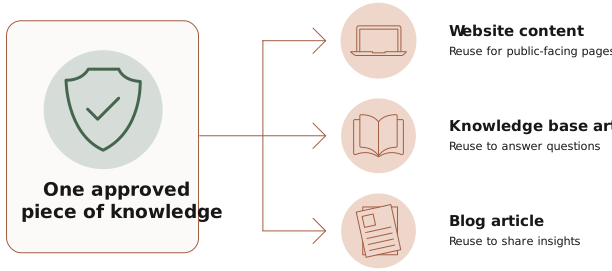
On the website
The customer might simply see:
Standard delivery takes 3–5 working days.
In the knowledge base
It might become:
How long will my order take to arrive?
with additional instructions and links.
In a blog article
The same approved information might support an article explaining:
What to expect when ordering from us
The presentation changes.
The underlying fact does not need to be reinvented.
Mojo principle: One approved piece of knowledge can support many different experiences.
Do you need all three?
Not necessarily.
The right setup depends on what your business needs.
You may need a blog if...
- Your goal is awareness and thought leadership
- You share opinions, news or stories
- You measure traffic and engagement
Example: Marketing Team
You may mainly need a knowledge base if...
- Your goal is to answer questions
- You help customers and staff solve problems
- Your success is measured by helping people resolve questions or problems.
Example: Support team
A Knowledge Catalogue is worth considering if...
- You create content in multiple places
- You need consistency and accuracy
- You reuse the same information across systems
Example: Growing organisations
At that point, the problem is no longer simply where to publish content.
It is how the business manages the knowledge underneath it.
What if you already have a knowledge base?
You may not need to replace it.
In fact, a strong existing knowledge base could become an important part of your Knowledge Catalogue architecture.
The first question should be:
Does our current knowledge base already give us the structure, governance and reuse we need?
Look at things such as:
- ownership
- approval workflows
- access permissions
- relationships
- metadata
- version control
- review dates
- integration with other systems
- public versus internal knowledge
- AI permissions
If the answer is yes, you may already have much of the underlying infrastructure you need.
If the answer is no, the goal is not necessarily to throw it away.
The goal may be to create a better knowledge layer around or underneath it.
What if you already have hundreds of blog articles?
Those articles are valuable.
A Knowledge Catalogue does not mean rewriting all of them.
Instead, you can identify the reusable knowledge inside them.
For example, ten blog articles may repeatedly explain the same product rule or expert recommendation.
That underlying information can be defined once as approved knowledge.
The blog articles can continue to exist.
They simply stop being the only place where that important information lives.
Which one does your business actually need?
A useful way to decide is to ask what problem you are trying to solve.
“We need to publish more useful content.”
Start with the blog.
“Customers keep asking the same questions.”
A knowledge base may be the immediate priority.
“Our information is scattered and inconsistent.”
Start thinking about the knowledge architecture underneath it.
“Several systems need to use the same approved information.”
A Knowledge Catalogue becomes increasingly valuable.
“We want AI assistants to use our business knowledge safely.”
You need to think beyond content publishing and consider structure, governance, access and AI permissions.
The answer may still be:
all three.
They just have different jobs.
The Mojo approach
We help you move from scattered content to a connected system.
We start with your most important knowledge. We structure it. We govern it. Then we help you use it everywhere it is needed.
Create once. Approve once. Structure it properly. Use it wherever it is needed.
So, what is the difference?
- A blog communicates ideas.
- A knowledge base answers questions.
- A knowledge catalogue organises and governs trusted knowledge so it can be reused across your business.
Get the structure right and your information works harder for you, your team and your customers.
One does not automatically make the others unnecessary.
The better question is not:
Which one should replace the others?
It is:
What does our business need its knowledge to do?
Once that is clear, the right architecture becomes much easier to design.
In This Resource
KNOWLEDGE TOPIC
- AI & Knowledge
Sub Topic
- Knowledge Architecture
Resource Type
- Comparison
Last Reviewed
- 4 September 2026